
The purpose of the Office of University Events is to manage, coordinate, and facilitate annual plans for both signature and marque events in the life of Winston-Salem State University. The primary function of the office is to support events that include university-constituent relations on behalf of the Chancellor, as well as senior administration. When necessary, the office also oversees interdepartmental coordination in order to organize and streamline the approach to university-wide events.

Levels of Support
- Creates and establishes initial engagement plan
- Manages complete event logistics
- Provides & manages staff and/or volunteers
- Serves as lead for any associated committees
- Manages all correspondence and guest lists
- Facilitates payment for outside agencies and processes internal accounting procedures
- Serves as a consultant on planning committees
- Provides direction and guided assistance
- Provides hosts and/or event attendants
- Serves as a consultant on planning committees
- Provides minimal support
Event Management

A University Event is either classified as a signature, marque, or collegiate event.
A Signature Event is defined as an event that is requisite in the life of the University. This event captures the heritage and spirit of the University and celebrates the legacy of the founder, as well as the importance of Winston-Salem State University in the larger Winston-Salem community and the surrounding area. These events are managed by the Office on behalf of the Chancellor and always receive full support. These events include, but are not limited to Homecoming, Commencement, Founder’s Day, etc.
A Marque Event is defined as an event that engages Winston-Salem State University constituents to participate and donate to the University. Most often, these events are planned in support of the Chancellor or the Division of University Advancement, and receive full or intermediate level support, based on directive from the Chancellor, Provost, and/or Vice Chancellor for University Advancement. These events include, but are not limited to ground breaking ceremonies/ building dedications, university anniversary events, scholarship events, donor focused events, faculty celebrations, etc.
A Collegiate Event is defined as an event that is planned by other agencies within the University. These events most often receive intermediate or basic level support, as determined by the Executive Director for University and Donor Event, or by directive given by the Chancellor and/or Provost.
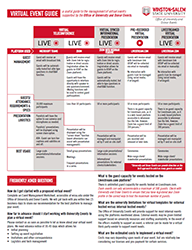
Please see our Virtual Event Guide, a useful guide to the management of virtual events supported by the Office of University and Donor Events.
For those that rely on assistive technology, please see our screen-reader accessible Virtual Event Guide.
Categorization Summary: University Sponsored Event vs. University External Partnership Supported Event
- Definition: An event organized and funded directly by the university. The university takes primary responsibility for the planning, execution, branding and funding of the event.
- Funding: Fully or primarily funded by the university, which may include the use of university resources, budgets, and grants.
- Organizational Control: The university has full control over the event's content, schedule, and logistics. This includes decisions regarding speakers, programming, and promotional materials.
- Purpose: The event is typically aligned with the university's mission, goals, or academic focus, such as student engagement, academic enrichment, or university culture.
- Examples:
- A lecture by a professor or invited academic speaker hosted by the university
- A campus-wide festival or open house
- A faculty-driven conference or symposium
- A homecoming signature event- example: Founder’s Day Convocation
- Definition: An event that is jointly organized or sponsored by the university and an external partner, such as a company, nonprofit, or other educational institutions. The external partner contributes to most cases full or partial resources, funding, or expertise.
- Funding: Partially funded by an external partner(s), in addition to or instead of the university. The funding may cover specific aspects of the event, such as guest speakers, venue rental, or marketing.
- Organizational Control: While the university may retain some control, the external partner has a significant influence on event decisions, including goals, funding resources, use of university branding permission approval from the university, and scope. The partnership often shapes the event’s focus and content.
- Purpose: The event serves both the university’s interests and the objectives of the external partner. It may focus on research collaboration, industry connections, professional development, or community engagement.
- Examples:
- A career fair sponsored by both the university and a corporate partner.
- A collaborative research conference with a business or nonprofit organization.
- A public event or panel discussion co-hosted by the university and an industry sponsor.
- Ownership and Responsibility: In university-sponsored events, the university holds full responsibility, whereas in externally supported events, there is shared responsibility between the university and external partners.
- Funding Sources: University-sponsored events rely primarily on internal funding, while external partnership events involve funding or contributions from outside organizations.
- Event Focus: University-sponsored events often focus on internal academic, student, or community interests, while external partnership events typically bridge academic goals with industry, professional, or community-oriented objectives.