
WSSU’s inaugural RISE AI Summit brings leaders together to explore future of artificial intelligence
Instead of asking how they can stop students from using artificial intelligence, college educators must teach students how to use it critically, ethically, creatively and responsibly, a national AI leader said recently at Winston-Salem State University’s inaugural AI Summit.
More than 330 people attended RISE AI on Sept. 10 at the Benton Convention Center, where 41 presentations explored AI’s growing role in education, business and society.
WSSU Chancellor Bonita J. Brown kicked off the summit by welcoming guests, followed by WSSU Provost and Vice Chancellor for Academic Affairs Dr. Stevie L. Lawrence II.
“For generations, we have been fascinated by the future, what it may look like, how it’s going to feel, how we might live, and, most importantly, what technology would make it possible,” Brown said before referencing the popular 1960s cartoon “The Jetsons,” which featured robots, flying cars, smartwatches and video calls.
“We’re actually living with most of those things that they envisioned way back in 1962,” Brown said. “But today, we find ourselves at a very different inflection point. AI is not simply introducing another generation of technology. It is changing how we teach, how we learn, how businesses operate, how industries compete, how research is conducted, how decisions are made and how we prepare people for careers that in some cases are still being defined.”
Brown and Lawrence both gave a special welcome to Dr. Siobahn Day Grady, a 2005 WSSU graduate who served as keynote speaker. Grady served as principal investigator on a grant that secured Google funding to help establish North Carolina Central University’s Institute for Artificial Intelligence and Emerging Research.
The 5,000-square-foot facility opened in August and is the country’s first dedicated AI institute at a historically Black college or university.
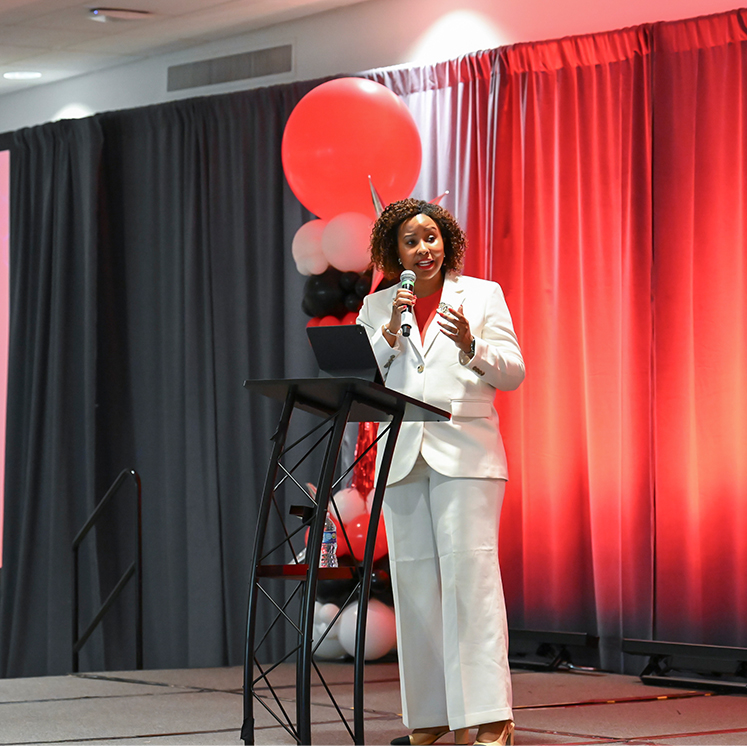
“The students in our classrooms today, we are preparing them for careers and technologies and opportunities that they cannot yet see,” Grady began her speech, titled, “Rise with Intelligence: Who Will Shape the AI Future?”
“So, I don’t want to spend our time today simply talking about what AI can do,” she continued. “I want us to wrestle with the bigger question: Who will shape what artificial intelligence becomes, and what responsibility do institutions like WSSU and others have in making sure that our students are among those people?”
Grady stressed that representation shapes outcomes. If the people building AI systems do not reflect the full breadth of humanity, the systems will not either, she said.
During her interactive address, Grady credited the strong foundation she received at WSSU with helping to prepare her to become a leader in the AI space.
Presentations were held before and after Grady’s luncheon address. Among them was one by WSSU assistant math professor Dr. Katie Johnston on student perspectives on artificial intelligence in undergraduate mathematics.
Senior math major Kevin Cole of Hickory decided to attend the summit after learning that Johnston, his advisor, was presenting. Cole said he thinks it’s important for students to have rules regarding AI usage.
“I don’t know what those rules are yet, but I think it’s important for students to be able to reason and come to conclusions on their own,” he said.
Allen Vincent, a first-year accounting major at Forsyth Technical Community College, learned of the summit from one of his former teachers at the University of North Carolina School of the Arts. He said he attended “to explain how robotics work and how AI and math relate.”
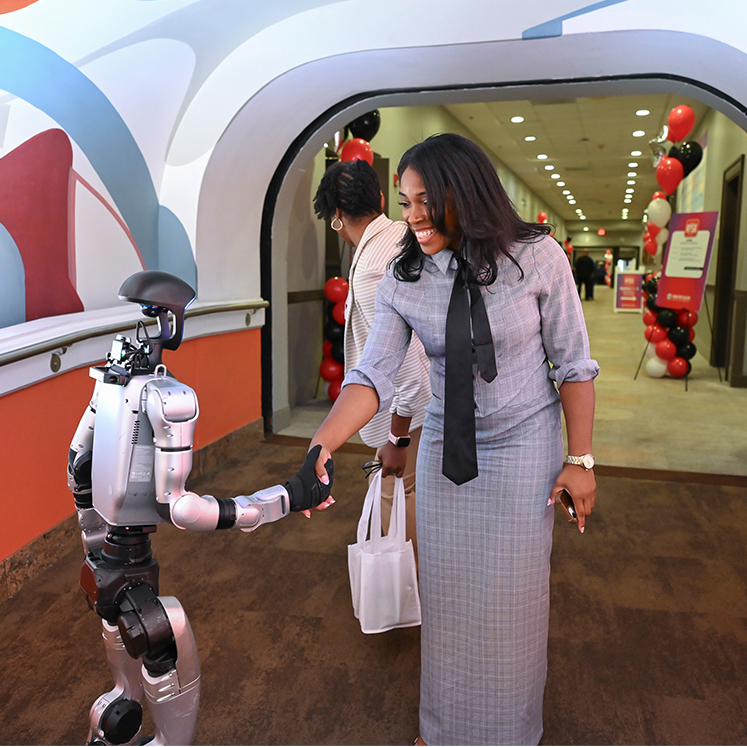
Vincent, a presenter at the summit, programmed the controls for a robot, interestingly named Ralph Lauren, which he operated at the summit. Ralph Lauren and Accra, a four-legged robot controlled by Nasir Melvin, a senior at Quality Education Academy in Winston-Salem, were a hit. Attendees and convention center employees took pictures with them, while others gazed from a distance.
“I feel like it’s really informational and important to bring awareness of AI to the community because knowing its capabilities and limitations is really important for its use,” Vincent said. “I really appreciate WSSU for hosting the event and thank them for bringing the presenters, which inspired me to learn more about this field.”
Vincent wasn’t the only one singing the summit’s praises. Many attendees said they were impressed with everything from the range of presentations to the WSSU branding that decorated the Benton Convention Center.
“I have truly enjoyed today,” said Trina Gabriel, an academic coordinator for the UNC Gillings School of Global Public Health. “Each of the sessions has built upon the previous sessions, so whether you’re a novice or you’re very experienced in AI, I think you can walk away with a nugget, a tip, a task that you can use that’s very practical but also pushing you to think in theoretical ways as well. I’m looking forward to next year’s [summit].”
Brown commended Dr. Jack S. Monell, interim director of The Center for Innovative and Transformative Instruction, who led the committee that worked tirelessly to facilitate the summit.
“The Rise AI Summit was an incredible success,” Monell said. “People stopped me throughout the day to tell me how much they enjoyed the event — from its flow and organization to their positive interactions with WSSU summit volunteers and the overall collegiality. They said they felt welcomed, like they were a part of the Ramily.”
Monell said the summit’s significance extended well beyond the event itself.
“Winston-Salem State University provided students, faculty, researchers and industry representatives a safe space to engage in intellectual discussion and debate about generative AI,” he said. “WSSU showcased some of its own talent, including our keynote speaker, who is an alumna, while also bringing together talent from neighboring institutions and organizations. Many of the attendees I spoke with said they can’t wait for next year’s summit.”
Click here to see AI photo gallery.